
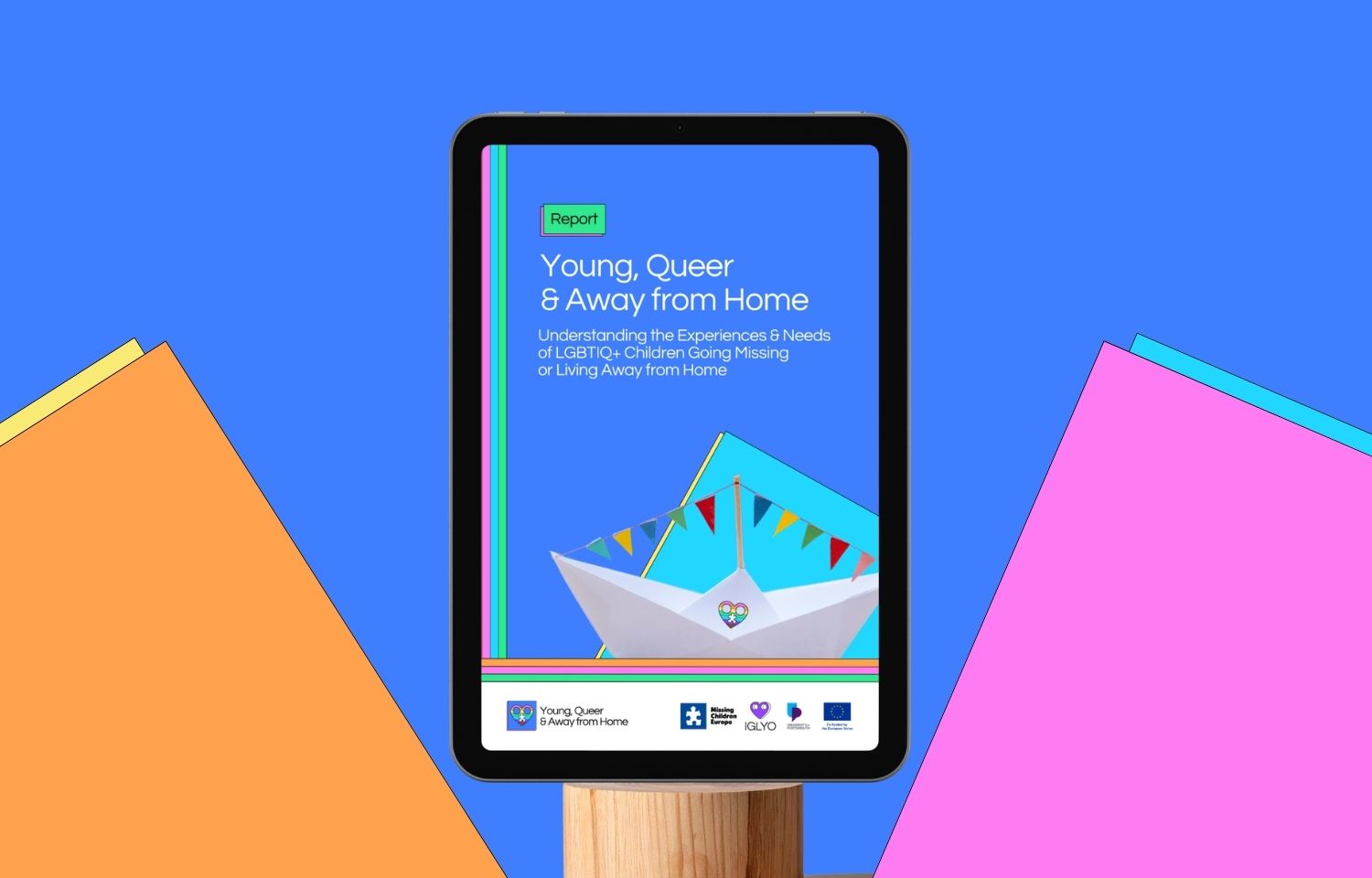
LGBTIQ+ Youth Facing Homelessness Do Not Find It Safe to Return Home and Face Barriers when Accessing Support Services, New Study Finds
Missing Children Europe, IGLYO — The International LGBTQI Youth & Student Organisation, and the University of Portsmouth’s new Young, Queer & Away from Home Study reveals that LGBTIQ+ young people and children under 18 who face homelessness, live away from home or "go missing" do not find it safe to go home, and further highlights the barriers they face when accessing support services.
Countless LGBTIQ+ young people and children under 18 decide to leave their home or are forced out because of who they are. Yet, until today, there was no robust, comparable EU-wide evidence on LGBTIQ+ young people and children facing homelessness, going missing or living away from home, despite clear signals that identity-based rejection, unsafe environments and barriers to support can drive displacement and harm.
With this in mind, Missing Children Europe, IGLYO, and the University of Portsmouth have just released their Young, Queer & Away from Home Study, which explores and addresses the experiences of LGBTIQ+ young people who faced homelessness, went missing or lived away from home before turning 18 in the EU or the UK on the one hand, and the experiences from youth workers and practitioners supporting them on the other hand.
One of the study’s key findings shows that, for LGBTIQ+ youth, leaving home is often forced or driven by survival due to abuse, rejection, unsafe conditions, and hostility towards their sexual orientation, gender identity or expression, and sex characteristics. Many study participants reported repeated episodes and long periods away from home, with returning home often not safe or desired.
“We have to name what’s happening here: systemic discrimination is pushing LGBTIQ+ children and young people out of safety. When families, schools, care settings and public services fail to affirm and protect us, leaving home becomes a survival strategy —not a choice— and the impact ripples through entire families, breaking trust and putting children and young people at greater risk”, said Rú Ávila Rodríguez (They/them), IGLYO’s Deputy Executive Director and Advocacy & Research Manager.
While returning home is not an option, seeking support can also become an obstacle course for many LGBTIQ+ youth and children. "For too many young people, asking for help is another hurdle. When services are affirming and practical, young people describe them as a lifeline, but when staff lack training, protocols or accountability, support can turn into harm and retraumatisation, especially in encounters with law enforcement and social services", further stated Rú Ávila Rodríguez. Worryingly, the study highlights a lack of medium- and long-term support, with gaps worsened by legal limits, lack of funding, limited staff training, and stigma and discrimination.
Additional layers of marginalisation make accessing support even more challenging. Trans and gender-diverse youth were a majority in the study sample, and bisexual youth were also prominent, which reinforces the urgency of addressing transphobia and trans erasure (e.g., misgendering, unsafe placement, denial of identity) in safeguarding and accommodation, and to address biphobia and bi-erasure in training and service design. More generally, many participants reported additional intersectional marginalisation, notably related to neurodivergence and disability as well as migration and religious minority backgrounds, which highlights the need for intersectionality in training and available support.
To prevent and address these situations, and ensure adequate support for LGBTIQ+ youth and children facing homelessness and exclusion, the study report concludes with concrete and actionable recommendations for EU institutions, national governments and support services: “Short-term fixes won’t end repeated displacement or stop children and young people from having to run. We need protections for LGBTIQ+ children and young people embedded in law, funding, safeguarding and service delivery (across the EU and nationally) so safety and stability are guaranteed, not conditional”, concluded Rú Ávila Rodríguez.
You can download the full report here. You can also download only the Policy Recommendations here.
Press enquiries
Jeremy Gobin (He/him)
IGLYO’s Communications & Network Manager
jeremy@iglyo.org
.webp)
About Young, Queer & Away from Home
Young, Queer & Away from Home is a 2-year project studying the views and lived experiences of LGBTIQ+ young people who experienced homelessness, lived away from their home or "went missing" before turning 18 in the EU or the UK through research, an online training for professionals, a resource hub, an awareness raising campaign and policy recommendations. The project is co-led by Missing Children Europe, IGLYO — The International LGBTQI Youth & Student Organisation, and the University of Portsmouth. Learn more.
About IGLYO
IGLYO — The International LGBTQI Youth & Student Organisation is the world's largest network dedicated to LGBTQI young people and their rights. We represent the voice of over 135 Member Organisations in more than 40 countries across the European region. We advance the rights of LGBTQI young people, advocate for their equality and inclusion, empower their voices, and connect them across borders through international events, capacity-building training, thematic research, advocacy, awareness-raising campaigns, network building, regranting, and intersectional community dialogues. iglyo.org
About Missing Children Europe
Missing Children Europe represents 32 Non-Governmental Organisations active in 27 countries across Europe for the prevention, protection and support of missing and sexually exploited children and their families. They provide the link between research, policies, and organisations on the ground to protect children from any form of violence, abuse, or neglect that is caused by or results from them going missing. Missing Children Europe coordinates the network of 116000 hotlines for missing children, and the network of cross border family mediators and facilitates coordination of cases that involve cross-border issues, ensuring that vulnerable children receive the help they need no matter where they are in Europe. missingchildreneurope.eu
About the University of Portsmouth
The University of Portsmouth hosts The Centre for the Study of Missing Persons, provides a clear focus for research into missing persons, for knowledge transfer and for educational provision, to academics, to professionals in the missing persons community and to relatives of missing people. port.ac.uk
Funding
“LGBTIQ+ Missing — The voice of LGBTIQ+ young people with experience of going missing before the age of 18” is co-funded by the European Union under the call CERV-2023-EQUAL (project number 101144825). However, the contents of the report are the sole responsibility of the University of Portsmouth, Missing Children Europe & IGLYO and can in no way be taken to reflect the views of the European Commission.
