
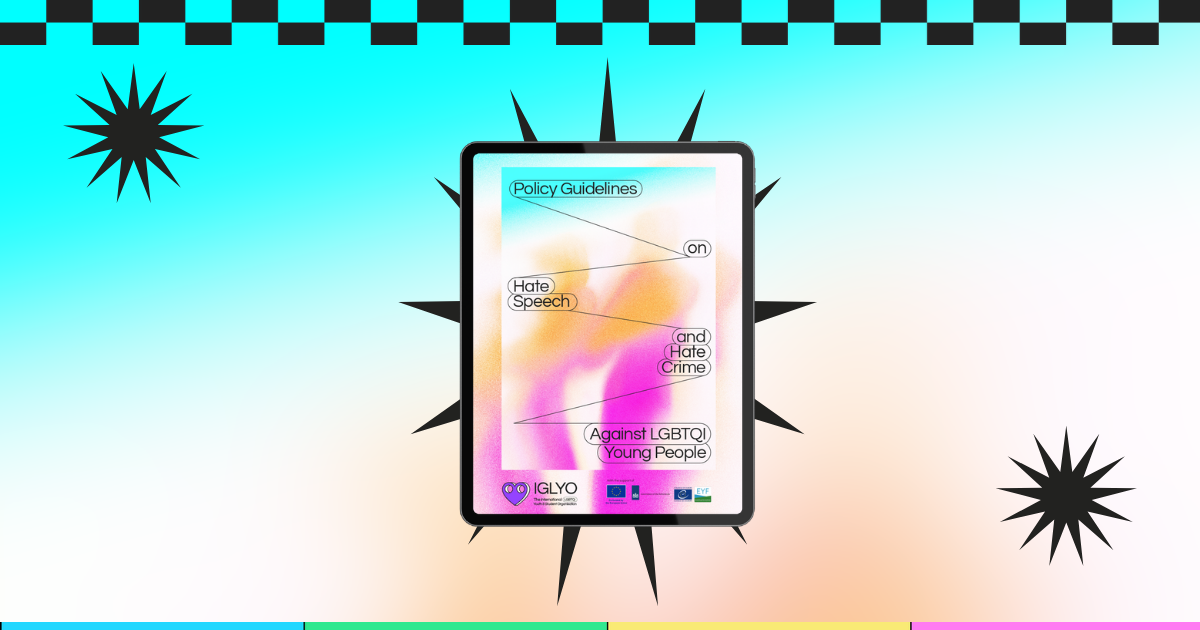
New IGLYO Policy Guidelines Call for Action Against Hate Speech and Hate Crime Targeting LGBTQI Young People
On today’s International Day for Countering Hate Speech, IGLYO — The International LGBTQI Youth & Student Organisation launches its new publication, “Policy Guidelines on Hate Speech and Hate Crime Against LGBTQI Young People”. This research provides practical recommendations for policymakers, educators, and civil society organisations to prevent and combat hate-motivated violence against LGBTQI youth across Europe.
In recent years, rates of hate speech and hate crime against lesbian, gay, bisexual, trans, queer, and intersex (LGBTQI) people have been rising across Europe. Although this affects the LGBTQI community as a whole, LGBTQI young people are disproportionately affected, particularly trans and intersex youth, LGBTQI youth from ethnic minorities, with migrant or refugee backgrounds, and disabled LGBTQI youth.
These guidelines explore the main forms and contexts of hate speech and hate crime affecting LGBTQI young people, recognising that such violence often occurs in educational settings or is often perpetrated by peers and family members. Each section outlines key definitions, examines the impact of these forms of violence, and provides practical recommendations for addressing hate speech and hate crime in the different settings where they occur. The publication also emphasises the importance of community-based and intersectional approaches to effectively prevent and combat hate speech and hate crime targeting LGBTQI young people.
"Addressing hate speech and hate crime against LGBTQI young people requires a comprehensive approach that tackles the conditions and narratives that drive prejudice and discrimination, including the growing influence of anti-gender movements and anti-LGBTQI rhetoric, stated IGLYO Policy & Research Officer Amélie Waters (They/them). As young people’s online and offline lives become increasingly interconnected, prevention, education, and meaningful youth participation are essential. Responses must be based on young people’s lived realities and developed with their involvement. Ensuring that all young people are safe, respected, and included is both a human rights obligation and a foundation of democratic societies.”
Most hate targeting LGBTQI young people goes unreported
Recent European research highlighted in our publication shows that 70% of LGBTQI youth aged 15–17 and 59% of those aged 18–24 had experienced harassment because of their LGBTQI identity in the previous year. These acts not only compromise their immediate safety but also seriously endanger their mental and physical well-being. More than half of LGBTQI young people reported psychological consequences following their most recent experience of hate-motivated violence.
Our research also highlights that hate speech and hate crimes rarely occur in isolation. They are part of a broader pattern of discrimination and exclusion that affects LGBTQI young people's ability to learn, participate in public life, and feel safe. Yet, the vast majority of incidents are never reported: 88% of LGBTQI young people aged 15–17 and 93% of those aged 18–24 did not report their most recent experience of hate-motivated harassment. These low reporting rates can be explained by the fear of not being taken seriously, concerns about being outed during the process, distrust towards authorities, lack of information on reporting mechanisms, and/or reluctance to report family members.
Those figures highlight that local, national, and international responses to hate speech and hate crime must be tailored to the specific realities of LGBTQI youth and include accessible, confidential, and youth-friendly reporting mechanisms.
Schools remain one of the most common sites of violence
As underlined in our recent IGLYO report, LGBTQI Youth Mental Health in the Spotlight, one in two LGBTQI young people have experienced bullying in school at least once based on their sexual orientation, gender identity, gender expression, or variations in sex characteristics. Additionally, 64% of LGBTQI young people report hiding their identity at school, while 46% report never openly discussing their LGBTQI identity in educational settings. This leads to 15% of LGBTQI young people aged 15–17 reporting having considered leaving school because of LGBTQI-motivated harassment.
Those figures serve as a reference point as the education sector has a duty to ensure safe and inclusive learning environments for all students. But efforts to tackle hate speech and hate crime must extend beyond the classroom. The values of inclusion and respect should be reflected across all aspects of school life, including policies, extracurricular activities, sports, and social and cultural events. Through our guidelines, we call for inclusive and LGBTQI-specific anti-bullying policies, mandatory training for educators, and inclusive curricula that promote understanding, equality, and respect for diversity.
However, education systems alone cannot succeed in this fight. National, regional, and local governments should actively partner with civil society organisations, LGBTQI youth groups, LGBTQI organisations, and research institutions to develop and implement effective strategies to prevent and counter hate speech and hate crime targeted at LGBTQI young people.
Online hate speech is a growing threat
While schools remain key sites where LGBTQI youth experience bullying and discrimination, much of this hostility now extends beyond the classroom.
For LGBTQI young people, the internet is often a space where they can learn about their identity, find information, and connect with others who share similar experiences. Yet, it also exposes them to significant levels of hate speech, harassment, and abuse. Among 15–17-year-olds, 46% reported that, in the previous 12 months, they had “often” or “always” encountered online calls for violence against LGBTQI people. Recent European research shows that young trans and intersex people, LGBTQI youth from ethnic minority and migrant backgrounds, and LGBTQI disabled young people are particularly vulnerable to online abuse.
With the normalisation and spread of anti-LGBTQI hate discourse online, our guidelines call for stronger regulation, transparent reporting mechanisms, responsible content moderation, and greater investment in digital literacy education. When designing any guidelines or curricula related to online hate speech, LGBTQI young people must be meaningfully consulted and included in the discussions, particularly given the prevalence and specific nature of the online hate speech that they face.
For some LGBTQI youth, hate starts at home
Our guidelines also draw attention to a less visible reality: hate speech and hate crime within the family environment.
Recent European research used as a reference in the publication found that 14% of LGBTQI young people aged 15–17 reported that the perpetrator of their most recent physical or sexual attack, motivated by their identity, was a family member. The rates were significantly higher among trans and non-binary youth: 1 in 5 young trans people and 15% of non-binary and gender diverse young people.
Many LGBTQI young people also report concealing their identities at home out of fear of harassment, threats, or violence. Being subjected to hate speech and hate crime in the family environment can negatively impact LGBTQI young people’s sense of identity, particularly for trans and non-binary young people. The consequences can be devastating, contributing to social isolation, poor mental health, and even homelessness.
To address these challenges, we recommend establishing dedicated support services that LGBTQI young people can turn to if they experience hate speech and hate crime in their family environment. Other recommendations include offering alternative pathways to reporting, developing community workshops, dedicating funding for LGBTQI youth organisations, and developing LGBTQI-specific training for healthcare providers, law enforcement, and frontline professionals.
Policymakers should also design stronger legal protections against hate-motivated violence within family settings. They should establish and promote accessible, confidential, and secure mechanisms for reporting hate speech and hate crime, with particular attention to the needs and safety of minors. In addition, legal safeguards and comprehensive support services must be in place for LGBTQI young people who may need to leave hostile or abusive family environments.
Building safer and more inclusive societies
Effective approaches to combating hate speech and hate crimes against LGBTQI young people must not only respond to incidents when they occur but also proactively prevent them by addressing their root causes.
Throughout the publication, we advocate for intersectional approaches that recognise the diversity of experiences within LGBTQI communities. As LGBTQI young people are not a homogeneous group, it is essential to acknowledge and address these complex intersections of identity when addressing hate speech and hate crime. LGBTQI young people from diverse backgrounds must also be consulted and actively involved in developing those policies, ensuring that they are grounded in lived experiences.
Community-based approaches are also essential when it comes to combating and mitigating the effects of hate speech and hate crimes against LGBTQI young people. They draw on the strength and resilience of marginalised communities and offer crucial support in areas where traditional state mechanisms may be inadequate. Such approaches can take various forms and adopt diverse strategies, including restorative and transformative justice practices.
By bringing together international standards, existing research, and practical recommendations, these new IGLYO “Policy Guidelines on Hate Crime and Hate Speech Against LGBTQI Youth” aim to support policymakers, educators, civil society organisations, and anyone working to protect and promote the rights of LGBTQI young people. Ultimately, our research seeks to contribute to safer and more inclusive societies where all young people can live free from discrimination, violence, bullying, and harassment.
Download the publication here.

Press enquiries
Jeremy Gobin (He/him)
IGLYO’s Communications & Network Manager
jeremy@iglyo.org
Yleanna Robert (She/her)
IGLYO's Communications & Network Officer
yleanna@iglyo.org
About The Publication
Policy Guidelines on Hate Speech and Hate Crime Against LGBTQI Young People was developed by IGLYO following its International Conference on Hate Speech and Hate Crime held in Ljubljana in 2023. The publication draws on the expertise and experiences of LGBTQI young activists from across Europe and provides practical recommendations for policymakers, educators, civil society organisations, families, and community leaders.
This report has been produced with the financial support of the Citizens, Equality, Rights and Values (CERV) 2021-2027 Programme of the European Union, the Dutch Ministry of Education Culture & Science, and the European Youth Foundation of the Council of Europe. Views and opinions expressed are however those of IGLYO only and do not necessarily reflect those of the European Union, Dutch Ministry, or Council of Europe. Neither the European Union, Dutch Ministry or Council of Europe can be held responsible for them.

About IGLYO
IGLYO — The International LGBTQI Youth & Student Organisation is the world’s largest network dedicated to LGBTQI young people and their rights. We represent the voice of over 150 Member Organisations in more than 40 countries across the European region. We advance the rights of LGBTQI young people, advocate for their equality and inclusion, empower their voices, and connect them across borders through international events, capacity-building training, thematic research, advocacy, awareness-raising campaigns, network building, regranting, and intersectional community dialogues. iglyo.org